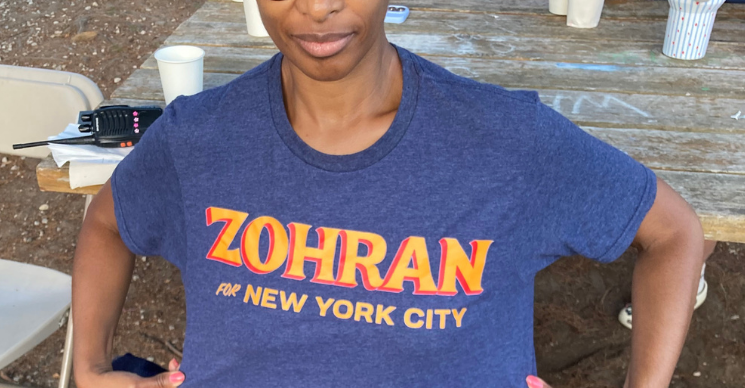



“Socialist Summer,” as dubbed by both its supporters and opponents, has swept the country following Zohran Mamdani’s win of the New York City mayoral race. Members of the Democratic Socialists of America (DSA) and candidates backed by the organization have had success in many other races, too; Chris Rabb in Pennsylvania, Claire Valdez and Darializa Avila Chevalier in New York, Melat Kiros in Colorado, and Donavan McKinney in Michigan all won their primaries.
But what is the DSA? Where did they come from so suddenly?
Or maybe not so suddenly. Adults and adolescents alike have been involved in the DSA for a long time. And they’re here now more than ever, backing Democratic candidates on seemingly every ballot.
Eighteen-year-old Senior Camper Brian L., who’s canvassed for DSA D.C. candidates for a few years now, described them as “[presenting] as social democrats, [but] they are very ideologically diverse.” He also said that they are closer to the Democratic Party of Franklin D. Roosevelt’s time than the Democratic Party today. Certainly, echoes of FDR’s inauguration speech can be heard in Zohran Mamdani’s own inaugural address.
Brian also attributed the growing Democratic socialist movement in the U.S. to a consistent leftist drift, citing influential socialists of the past such as Eugene V. Debs, the first presidential candidate on a socialist party ticket, and Martin Luther King, Jr., whose famous ‘I Have a Dream’ speech contains fundamental socialist ideals. “I do feel like it was inevitable that an anti-establishment political movement would rise to power, given the current state of things,” he said.
Change, still, is slow. When asked about how she’s seen the public perception of socialism change, instructor Eunju N. said “I don’t know how much conversion there’s been in people initially unsympathetic to socialist ideas.” To her point, the controversy that followed the NYC mayoral election has a lot to do with communism. In America, communism and democratic socialism are seen as synonymous with each other and both “unpatriotic.”
“Socialism is ultimately an ideology of necessary regulation and betterment of everyday life,” Brian told me, which seems pretty simple for an ideology colored by controversy. It is true that democratic socialism is different from socialism: the former seeks to use the established structure to promote change, while the latter is in favor of complete abolition of capitalism. Either way, however, the word “socialist” has long been taboo in our political landscape.
There’s a history behind this: after World War II, the Cold War saw the U.S. government spreading anti-communist propaganda which endures to this day. Several campers I talked to said they’d been taught about communism, and as a result socialism, in a negative way. “In history we’ve seen leaders abusing [communism], so it gets vilified,” explained 17-year-old Senior Camper Asha H. “Every ideology has its flaws,” she added. This seems especially important to note in the context of the current political landscape of the U.S. Our country is in the throes of late-stage capitalism, plagued with issues such as violent and racist immigration policy, rapidly accelerating climate change, and financial backing of the genocide in the Middle East.
An unexpected recurring theme that came up in my first few interviews is the Israel-Palestine conflict. When asked about Mamdani and socialism, an anonymous middle camper told me, “He’s a pretty good mayor. I definitely agree that there shouldn’t be religious states.” She was referencing Mamdani’s recent statement against nations that privilege one religion over another, in which the mayor specifically referenced Israel and Saudi Arabia. Her musings on Israel and her identity as a Jewish person in (positive) relation to Mamdani was unexpected and unprompted, and led me to further investigate this facet of the issue. At first, I assumed that Mamdani was the source of the apparent connection between Israel-Palestine and socialism. Much of the controversy around New York’s new mayor has surrounded how his vocal pro-Palestine stance may affect Jewish New Yorkers. Upon further investigation, I learned that some campers had different perspectives.
Sixteen-year-old Senior Camper Lili S., who is an active member of the NYC-DSA, flipped the causality, seeing Mamdani’s rise as partially a result of increased attention to Israel and Palestine. “I think the obvious structural rot that led even the most ‘progressive’ people to align with a far right, anti-LGBTQ, racist government in order to fuel a long campaign of genocidal annihilation brought people to a more structural view of oppression. And thus to socialism,” Lili said. Asha, whose interpretation was closer to my own, said that “it is impossible to separate most people’s opinions on socialism from Israel-Palestine, because I think there are so many people who have started to engage in that conflict because of Zohran.” It seems that both narratives may be partially true.
Issues such as Israel-Palestine, around which more Democratic Party consensus existed in previous years, have become major flashpoints of division in the left-aligned public. Making every faction of the Democratic Party feel represented is a fine line to walk, and the establishment core of the party seems to be trying and failing. Indeed, many of the complaints against Democrats like Joe Biden and Hillary Clinton is how centrist they’ve turned, and how they’ve failed to convince swing-state voters that their lives would be better with them in charge. They’re murky on most issues and seem unwilling to challenge the status quo in a way that makes real change. The DSA, while not a party itself, is definitely gunning to take over the establishment and redefine its values.
So where is this going? What does the future hold for the United States’ splintering Democratic Party? “I would like to stand up and say the DSA has broad appeal, but clearly it’s demographically grounded,” Lili told me, “and I think we see that where youth voter turnout and DSA wins are basically entirely correlated.” Yet again, as we see so often in politics, it seems to be a case of young versus old. The establishment Democrats (often aged 70 and up) stand for the norm, while the youthful DSA pushes for change. And it is clear there must be change.
“In terms of economics, the current state of the American free market is not a free market at all: we engage in a market where oligopolies dominate very large shares of the market. And there is no other way to deal with such markets unless by regulation,” Brian told me. In addition to Mamdani’s economic vision, democratic socialist politicians like him also seem to be more responsive to a range of constituent problems than establishment Democrats. As Asha put it, “The fact that we see him responding to day-to-day troubles like the potholes shows how we are seeing a wave of demand across the country for candidates that respond to complaints. Regardless of your views on him, I think he’s a very important symbol of a change in American politics.”
Reflecting on the shifts in contemporary politics, Asha said, “As we are all becoming adults in this world, we care about minimum wage, all these things necessary to live. I do think it’s partly age, but also there are things happening in the world that have awakened us.” Brian similarly emphasized the importance of youth in politics: “Although there is a DSA tide, it’s up to us to uphold that. We’re active agents, not passive observers.”