


What does it mean to build a community? To break one apart? To be part of one?
The way we protect one another and seek out diversity at WriCampia could be a hopeful model for the sort of active role we should all play in our local communities, as many of our neighbors and friends experience fear and threats from growing ICE presence.
Over the past year, Trump’s attacks on immigrant communities have increased exponentially, ICE raids have become expected through my hometown of New York City, innocent people have lost their lives to ICE agents, programs meant to protect immigrant children have been quietly but dramatically rolled back, and the fears my friends experience on the subway have worsened.
During this same period, I have been in micro communities that emerged from the hardship.
As many of us watched communities torn apart on the news, my own student community came together to fight against it. As we listened to our president’s dreams of establishing a type of exclusionary American populace, I was invited to countless WhatsApp groups alerting local communities of a potential ICE presence, helping vulnerable families and people avoid ICE agents and the areas they’re surveilling. I was raised on a patriotism rooted in a deep appreciation for the country that took in my immigrant great-grandparents when other nations wouldn’t, and I’ve wrestled with this reclamatory love for this country while in deep pain for the communities that are being pulled apart.
Relying on and contributing to the strength of our communities, whether they be local or student or familial, has never been more crucial. WriCampian shared values of inclusion—that spans ancestry, race, gender, ability, background, age, creative interest, and more—are essential to our communal culture and lay the foundation for WriCampians’ social activism and creative vision.
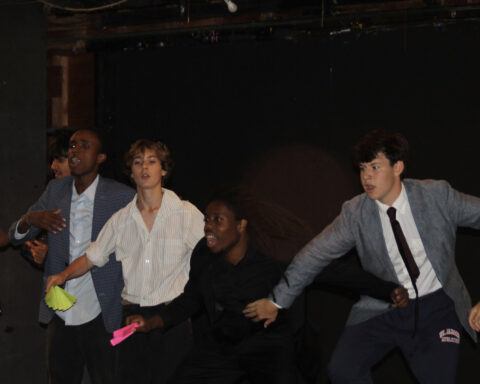
Walking through the dining hall during dinner, you’ll hear campers excitedly sharing their projects for their different tracks, a portfolio camper acting in a filmmaker’s movie, a filmmaker begging to read that camper’s work. In theory, the United States of America should be the same: new communities forming as immigrants bring pieces of their nation to ours, different aspirations interconnected. Because of this, the WriCampian community offers a clear lens through which to view the Trump administration’s attacks on immigrants: community upheaval hinders the fabric of our society through fear and the threat of homogenization.
The clearest and most dangerous effect of societal homogenization is the subsequent marginalization of racial minorities. Despite the Trump administration’s claims that their targets are undocumented immigrants, documented immigrants and even people of color born in America have been profiled and repeatedly targeted by ICE raids, questioning, violence, and being detained. The effect is fear that extends beyond undocumented immigrants and to immigrant and POC communities on a larger scale.
Starting last year, friends of mine who were Hispanic, looked Hispanic, or were Black began to carry around IDs, passports, and proof of citizenship. Another friend of mine began shaving his beard to appear less “ethnic.” Other families considered self-deporting, despite the fact that the children of the family were born in the US. Across New York City, people who are or could be mistaken for immigrants have made fear-driven life changes to avoid being caught in a brush with ICE.
A camper from Yonkers, an independent city in Westchester County right above New York City, shared with The Yearly WriCampian that their father was deported a few months ago. Another respondent from Brooklyn shared that ICE would regularly question students at the immigrant-majority bilingual school where their mother taught.
Over on the West Coast, an LA camper shared, early June was filled with LAPD-assisted ICE raids. They shared that many people brought their IDs with them absolutely everywhere they went. Since their mother was only recently naturalized, her citizenship felt fragile, which meant that they often felt unsafe in their own home.
Another camper shared that their father, a lawyer, visited Delaney Hall Detention Facility in Newark, New Jersey and witnessed horrific conditions there. “Help Me” had been written by detainees on the facility’s windows.
Even at camp, our supposed safe haven from the happenings of the world, campers carry the weight of the domestic and foreign policy agendas broadly, and their community’s traumas and fears related to aggressive immigration policy particularly.
When large groups of immigrants are deported or detained, others self-deport, and still others quiet their voices and presences to avoid attention. A much smaller minority remains.
The longer-term effect of governmentally-enforced societal homogenization is the loss of cultural diversity and richness.
Without this pluralism of opinion, interests, and backgrounds, WriCampia wouldn’t be the community we treasure. The same holds for the United States, and so, it’s imperative that we fight to preserve the beautiful heterogeneity that animates our country.
The near-universal support found at WriCampia offers a motive and a framework for actively supporting our communities in this fight. When older campers see younger campers wandering at night, they help them find where they’re going; when someone’s crying, the first person who sees them stops and checks in; when someone feels bullied or hurt, others come together to make them feel supported, and confront the inciter.
It’s more than likely that your city, neighborhood, or town, especially if you live in or near a city often targeted by Trump’s Department of Homeland Security, has a multitude of platforms for reporting ICE presence and ensuring your neighbors’ awareness, whether via social media or group chat. Groups like Know Your Rights create materials, cards, and flyers to give out to your community explaining what to do in case of a run-in with ICE. Groups like Never Again Action conduct skill-shares and direct actions.
Here at camp, we also create change on a material and practical level. First-aid kits can be found in every space at camp with counselors trained on how to use them, and snacks are distributed throughout the day. The type of systematically-normalized support that’s built into our daily structure at camp is the type of mutual aid that we have the ability to normalize within our communities at home, except in mitigation of abusive immigration policy rather than paper cuts and hungry stomachs.
A less direct but long-term contribution you can make to your immigrant communities is by lobbying your congressional representatives. There are currently petitions and acts pending that would protect immigrant communities, and specifically, the children of immigrant communities. DACA and TPS may have been overturned, but acts like the Dream and Promise Act have enormous potential to replace them and effectively protect undocumented youth. Enough congresspeople need to sign off on these acts in order for them to pass—and you are able to lobby your congresspeople to add their signatures. Congresspeople and senators cater towards their constituents, who aren’t just voters; they’re every single person, regardless of age or voting status, that lives in the district or region they represent. Your voice truly matters, as they want to be liked by the public and to be reelected. Pressure works. Both this year and last, WriCampians wove references to their experiences at Ice Out and No Kings protests–and especially their school walkouts–throughout camp conversations. The power of protest cannot be overstated: when entire nations take to the streets, collective concern and anger is taken seriously. When single communities or schools take to the streets, the foundations of movements are built. The people you bring along with you and meet at a rally will be the same people to whom you’ll turn to organize at scale, make “ICE presence groupchats,”, and coordinate lobbying efforts.
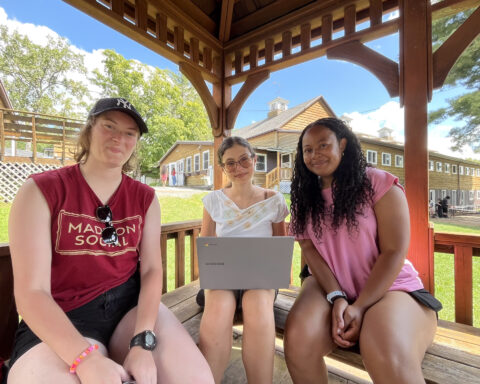
I’m still learning how I can best contribute to my local community each day, still deciphering what my role as an activist and ally should be. But as I write this sitting in the newsroom late into the night before the Yearly WriCampian final deadline, my friends from filmmaking and portfolio track sit editing with me with no reason to be other than compassion.
And I understand what being part of a community should mean a little bit more.