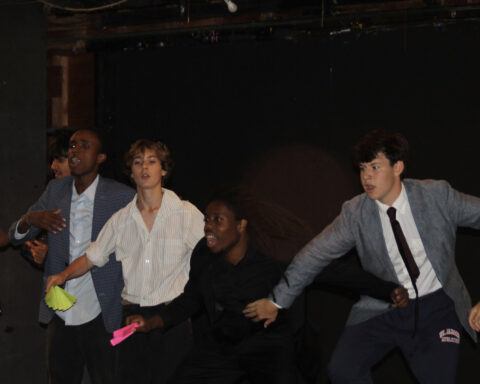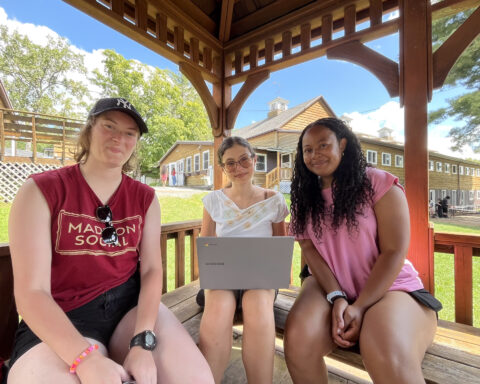



“At first, I naively thought that A.I. would never become a Writopia issue since our kids and teens are coming here because they love to write or want to develop their confidence in writing,” said Rebecca Wallace-Segall, CEO and founder of Writopia Lab. “But last year, we discovered that an anxious middle camper leaned on A.I. to generate her pieces when faced with the pressure of a deadline.”
Even though WriCampia had several A.I. blockers in place, the middle schooler was capable of finding an obscure A.I. platform. This was a revelation for Writopia staff: A.I. had a growing presence in their writers’ lives and it was time to take a clear stand against its use within their programs.
A new A.I. usage policy was developed for Writopia Lab earlier this year by several prominent members of Writopia staff, namely Rebecca W-S, Matthew Jellison, Elsa Bermudez, Bianca Turetsky, Léna Roy, and Eunju Namkung. This year’s WriCampian campers are the first Writopia Lab writers required to sign the new contract that states: “I agree not to use A.I. in my writing, outlining, research, or anywhere else in my time in workshop at Writopia Lab. I understand that Writopia Lab does not publish, produce, or workshop any work that was created with an A.I. tool.”
For the 2025-2026 school year, Writopia writers did not have to sign the agreement, but adults and instructors were informed of the policy and encouraged to share it with writers. All Writopia writers in the 2026-2027 school year in all regions and online will be required to sign the contract to participate in workshops.
“While I understand that many schools need to lean into A.I., Writopia can and should remain an A.I. free space where kids can become fully developed thinkers and writers,” said Rebecca W-S.
Young people are now growing up in an era where using and consuming artificial content is almost unavoidable. Since the release of ChatGPT in November of 2022, A.I. tools have proliferated. With this technology comes the careless use of A.I. to generate videos and images on social media, articles on the Internet, and generalized slop. Children are now growing up in an era where using and consuming artificial content is almost unavoidable.
“As children become more literate in A.I., particularly at a young age, they will become increasingly reliant on the tool and inevitably lose confidence in their own abilities,” said Rebecca. “The stakes are too high.”
Many campers agreed that their peers often rely on A.I. to do things that they could do themselves and found this concerning because it is diminishing their peers’ creativity and authenticity.
“Some of my friends use it to do their homework or to write ideas instead of coming up with them on their own. It’s not a good thing to use A.I. as an escape to make something easier,” said Lily B., 14, who intentionally does not use A.I. because of all of its negative impacts.
“It is important to exercise your mind and write from your heart. A.I. doesn’t have a heart, it can’t love and it can’t feel. It’s not sentient and it can’t replicate things that it hasn’t experienced,” said Ashley G. 16.
Despite the sentiments among WriCampians, there is a global appetite for A.I.-generated content. In a study conducted by computer scientists at the State University of New York at Stony Brook, it was found that in 2,168 of the random sample of 14,419 self-published novels released on Amazon between January 2023 and March 2026, more than 50% of the prose was A.I.-generated.
Many campers also voiced concerns about A.I.’s negative impacts on the environment. A.I uses millions of gallons of water in order to function, which is extremely detrimental since water is a finite resource.
Not all campers share a completely scalding view of A.I. Several campers shared that A.I. can be extremely efficient and important in the worlds of science and medicine. Ivy G., 12, said, “The only slightly positive feeling that I have about A.I. is that it’s being used to find cancerous masses before they become dangerous.” Anna K., 16, explained that A.I. is excellent at pattern recognition, allowing it to be used for a variety of purposes, including finding structural failures in the Vatican City.
Additionally, Maya S., 16, shared that A.I. can help her a lot on school projects with tasks that are time-consuming and do not require generative A.I., such as parsing through sources to find quotes and facts. She pointed out that because a lot of her peers use A.I., not using it would mean falling behind and being unsuccessful in school.
While some might see the positive or necessary aspects of A.I., Writopia’s new policy has had overwhelmingly positive feedback from campers. Most campers were shocked and a bit disappointed that an A.I. policy would be necessary at a writing camp, but all believed that it was valid and reasonable to ask a group of kids who came to camp to be creative to abstain from using A.I.
“This is an art-based camp,” said Lily. “No one should rely on A.I. to do the work for them when you’re literally coming here to be creative.”