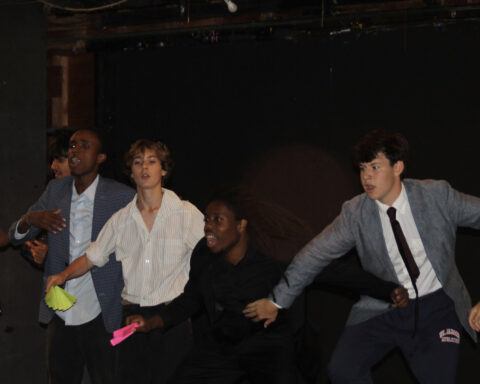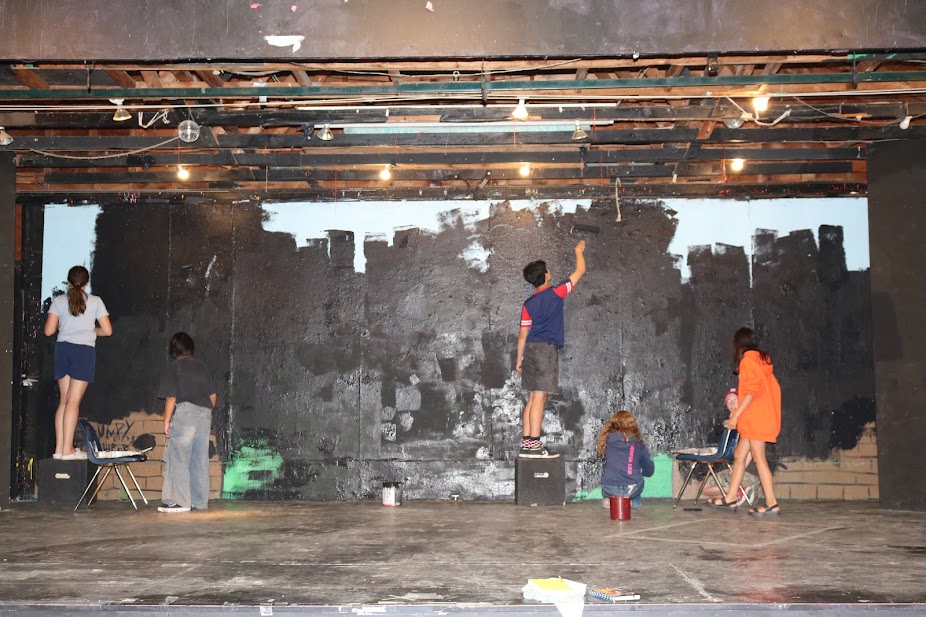



The Page 2 Stage performance is one of the most highly anticipated showcases for WriCampians. Each year, there’s a new story, new songs, and new faces. While the Yearly WriCampian traditionally covers the overall performance, the show’s creative process and technical aspects deserve equal discussion.
The process, design, and execution of set-making are as essential as the players on the stage, and as memorable.
Campers who were here last summer may remember the checkered suit of cards background of the casino musical. Rather than being painted, each rectangle was a piece of paper, arranged flawlessly to mimic a real checkerboard. The individual who came up with that idea—and ran on stage during intermission to fix a wonky paper—was Charlie J., a 13-year-old in Middle Camp. This year, Charlie will be working on the Page 2 Stage set again, and he walked me through how he transforms a bleak wall into an immersive scene in six or seven hours.
As ever, the first step in any creative process is idea generation. Charlie told me that as the Page 2 Stage groups split up and start talking about the script, he draws ideas and asks for feedback from his friends. He also free-associates based on the groups’ conversations, and implements them into his design. He focuses mostly on the background because “you can’t pantomime”; you can’t pretend there’s a blue sky, but you can pretend there’s a rug in the foreground. This also has a large impact on the overall performance, because the audience can contextualize the characters with their surroundings. As Charlie put it, “you’re not just seeing a play; you’re seeing something happen.”
Executing the plan is more concrete; there are certain materials set-makers have to collect and props they have to make. When asked about what materials are normally used in set design, Charlie responded, “We’re just using whatever supplies are in the art room.” Using the materials on hand to make something entirely different allows for out-of-the-box thinking. For example, one year the Page 2 Stage members made a zipline gun out of paper. Charlie and the other set-makers also “get less than what we need, so we never get too much.” This provides a sense of order to an otherwise overwhelming process, and upholds environmental sustainability.
Anyone interested in helping make the set has several different aspects they can focus on: design, resource-gathering, or execution. Charlie excitedly announced that “people should join tech; we love the help, and it’s really, really fun.” Honestly, after seeing how cool the process is, I was tempted to break away from Newspaper and run to tech, too.